Tuesday, July 11, 2017

Back in the Tank: 'Altered States' and Where '70s Experimentation Meets '80s Sci-fi Pop


As we all know, the '70s in Hollywood is seen as a second Golden Era, where scrappy film school grads came into their own, using big money from eager studios to rope in a youth generation raised on a druggy counterculture vibe.

Scorsese, Coppola, Lucas, Spielberg, they all went big ideas and bigger budgets by the time 1980 rolled around. Ken Russell, the iconoclastic British director was a bit older than this crew and spent the '70s breaking down boundaries with films like the controversial anti-religious bombast of The Devils and the more user-friendly, rock opera psychedelia of The Who's Tommy. Russell was also edging toward the mainstream by the end of the '70s, looking for a pop hit that mixed his opulent weirdness and some kind of sci-fi angle that Hollywood was gaga for, post Star Wars.


[Back in an era when movie posters were allowed to have paragraphs of copy on them for movie-goers to read. We'd be lucky for a full sentence nowadays.]

Russell adapted the sole novel by Oscar-winning screenwriter Paddy Chayefsky (the genius behind Network) to the screen with his usual psychedelic aplomb. This is the story of Edward Jessup, a research psychologist (a striking William Hurt in his screen debut) studying schizophrenia by using sensory deprivation in an isolation water tank.
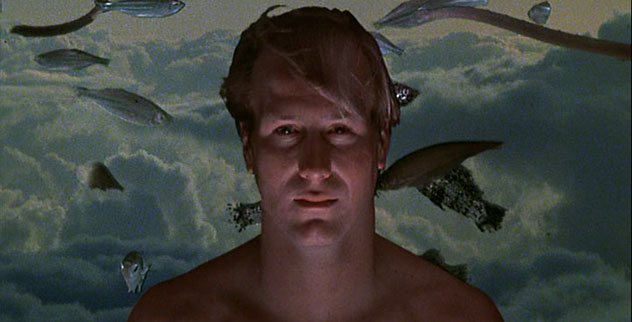


This deprivation isn't enough to get the out of body experiences he desires, so he travels to remote Mexico to experience a sacred drug ceremony. There, the natives use a special hallucinogenic natural potion to open up their consciousness. Jessup tries it and is hooked on the mind trip hallucinations.


Back in Boston, Jessup mixes the isolation tank experience with some of the mind-altering drug mixture from Mexico. This is when the film gets truly silly and Hurt's hallucinations manifest themselves physically. He starts to morph into a caveman/animal state, escaping the tank and running amok through the nighttime city streets.

Altered States is a whole lot of mumbo jumbo, psuedo-science but makes for a fun, dated ride through theories about "biological devolution," energy waves, and bad primitive caveman bodysuits. It's the dead serious, existential questions about the origin of man and men becoming godlike through drug and mind-expansion tools that all seems very '70s self-help meets heavy drug experimentation. Russell puts this through a filter of a glossy, FX-heavy sheen of the upcoming '80s wave of sci-fi, horror, and action films about to barrel through Hollywood and become the norm.

Altered States rides the tightrope between the two decades and between exciting boundary-pushing and schlocky fun. It's too silly to even get mad at. C'mon, we're all just energy, man! Enjoy the ride.


Dessert Anyone? 'Beatriz at Dinner'


Sorry for a blog vacay, but we had guests in town but nothing that would constitute a dinner party like the one in Miguel Arteta's new film Beatriz at Dinner.

Arteta, director of dark comedy slices of life like Chuck & Buck and The Good Girl, once again teams up with his writing partner, the wry and dry Mike White, for Beatriz.

Car trouble strands masseur/alternative medicine therapist Beatriz (the dressed-down, stunning Salma Hayek) at the oceanside mansion of one of her clients, Kathy (Connie Britten) post-session. She's invited to stay for a small dinner party. The guests include Kathy's stuffy, uptight husband, and his business associates, including the uber-wealthy CEO of a chain of hotels and resorts Doug Strutt (John Lithgow, playing creepy jerk again).

Beatriz's calm, open persona gets battered as she listens to the stories of greed, inanity, and selfishness from the wealthy white people sitting next to her at this lavish dinner table.


As the night moves on, the drinks are consumed, and Lithgow's character reveals himself to be a Trump-like classless, arrogant mogul who has leveled small towns, like the ones that Hayek's character comes from in Mexico, to make way for his luxury resorts. Beatriz moves from apologetic and gracious to silently, and then not so silently, seething.

Many critics have complained that the satire and comedy elements are not scathing enough in the film, while also complaining that the "villains" in the film are too one-dimensional.

I disagree. On reflection, the layers of this film are subtle when they could have turned into the over-the-top dark comedy of something like the liberal vs. conservative battles of the '90s indie The Last Supper . Beatriz approaches a vaguely similar "us vs. them" set-up, but adds the weight of race, class, and environmentalism, to take the idea of the story to a sadly accurate spot in 2017 America.


Although the ending is a bit pessimistic, it's also reflective and powerful and doesn't give anyone an easy out. Beatriz, mainly due to the haunted and silently commanding presence of Hayek, jumps over the danger of sermonizing, to focus on one single person and her small life affected by a wave of greed and narcissism that has flooded over this country in an era of corruption in the highest offices of the land.


Tuesday, June 20, 2017

Long Train Running: the Killer Zombie Movie that is 'Train to Busan'


You can't complain that there's always endless crap movies to scroll through on Netflix when you do stumble upon a gem. Well, stumble might not be the right word. Train to Busan was recommended to me by a close friend with stellar horror movie taste, but it is still one of those thumbnail images on Netflix you might have passed up. Don't.

Seok-woo, a frazzled businessman, agrees to take Soo-an, his melancholy young daughter to visit with his estranged wife in Busan, a city in South Korea that is a few hours by train. Before the train pulls away from the station it gets an unexpected and unwanted new passenger, a teenager infected by some kind of zombie virus. Things get worse, quickly.

We've all seen zombie movies before, but have you ever seen one on a train, that plays out like 28 Days Later meets Snowpiercer, at 100 mph?


The large crowd action sequences, with hordes of zombies moving quickly is terrifying (see above image) and perfectly staged. The CGI is tastefully done which adds to the realistic high tension and scares.

What saves this from being a rote, seen-it-before snore are the fleshed out characterizations of some of the main players in the film. I really ended up caring about Seok-woo and Soo-an and their emotional bond that drives the movie; that makes their race for survival that much more powerful.


Sang-hwa, a beefy working class dude and his pregnant wife Seong-kyeong are another set of characters that jump beyond stock filler; their subtle humor and duty to step up and fight make Train to Busan more of a well-rounded experience. Yes, there are multitudes of zombies to kill in order to escape but I want to care about the people who are escaping, or else they would just become more food for the blank-eyed hordes.

Monday, June 12, 2017

A Wee Bit Better Than You'd Expect - 'T2: Trainspotting'


Late to the game here, I know, since the sequel came out in America in March, but I finally caught T2 Trainspotting. Not quite my fault, since the rollout of this film in America was very small and lackluster for being a sequel to such a pop culture smash from the '90s. It was hard to find a screening until it came to second-run theaters.

With a bigger budget than the original but only half of the box-office take and teamed with rather mediocre reviews, T2 had the aura of a bit of a failure. That unconsciously also probably added to my reluctance to chase down the movie when it opened. Was it also the worry that this sequel would squash my cheerleader feelings about the original, which made such a huge splash among twenty-somethings like me in the '90s? It was such a cultural touchstone when it came out right at the peak of Britpop and the New British Art movement, with a huge audience of American youth going gaga for the film.


One huge selling point of the original was the soundtrack, with its mix of Britpop luminaries (Blur, Pulp, Elastica) and classic cool rock (Iggy Pop, Brian Eno, New Order). Although music is present in T2, it seems to fill more of a background role throughout, with the same reliance on old classics (Blondie, The Clash, Queen) and new Brit artists (Young Fathers, Wolf Alice).

The missing spark seems to be this sad American 21st century complete lack of interest in British rock/pop/dance music, probably for the first time since pop music began. The music element becomes almost an anonymous non-event in T2, which is such a 180 from the selling point excitement of the original. Maybe it's the loss of excitement and monolithic power music has overall in mass culture in 2017.


Nostalgia and the world moving on without care is a strong thread throughout the film. And this is the selling point for the successful moments in T2. The film has a massive melancholic streak that the exciting, caper-filled elements of the original film lacked. There is less drug taking in T2 than Trainspotting, and more talking. There's the beaten-down, forty-something "what the F*&% am I doing with my life?"/one-last caper heaviness that permeates and gives it a bit more weight than you would think it could muster.

Ewan McGregor and Jonny Lee Miller look weathered in all the right ways in their return as Renton and Sick Boy. And all the main actors have gotten skillful with nuance over the past 20 years (especially goofy Ewan Bremner). Flashbacks are dotted throughout T2, but it's a better film when it sticks to the present day. It makes for maybe a less fun, but more believable ride.


Thursday, June 1, 2017

Long Train Running: Finally, 'Murder on the Orient Express' - the First Trailer


After the Entertainment Weekly cover teaser, we finally get the first trailer to the November release of Murder on the Orient Express. And no, I don't mind Kenneth Branagh's epic moustache as Hercule Poirot.

We have great cinematography, lush costumes and interiors (this was key) and some darting eyes, panicked voices, and Michelle Pfieffer giving us her best Madonna looks. We may even get the first subtle Johnny Depp performance in years, if that's possible.

Nice onscreen intro text to each character, to let newbies know who everyone is. I'm hoping screenwriter Michael Green's adaptation keeps the flavor of the 1974 version but adds his own twists and details.

"The murderer is with us, and every one of you is a suspect."

Tuesday, May 30, 2017

Micro/Macro: the Big and Small Stories in British Horror


Tons of horror movies come out weekly and it's hard to keep up. It certainly is one of, if not the, highest volume film genre. It's great to see smart, budget-conscious (I won't say "cheap" cause that implies they're tacky, home-made little projects) horror films released amidst all the hackneyed movies that fill up the Netflix 'Horror' genre listings.

Two new-ish jewels that came out recently are from the UK area, and tell both intimate and larger-scale stories of various kinds of horror.

The Girl with All the Gifts (see above trailer) is of the "macro" kind, a somewhat small story encased in a larger, epic environment of global collapse after a zombie virus. In a militarized UK, a collection of hybrid, second generation children are incarcerated and used as test subjects for curing the virus.

Glenn Close stars as the head scientist who sees the cure as the shiny goal, whereas the children are all expendable specimens. The children's teacher Helen (Gemma Arterton) is the more empathetic heroine, and her favorite student is the titular character, the whip-smart Melanie (Sennia Nanua).


After an attack on their base, the core group of survivors make a run for it and it becomes a road zombie movie, in the vein of 28 Days Later or The Walking Dead. The effects are smart, small, and subtle. Aside from fallen city landscapes, any CGI nonsense is smartly kept to a minimum.

The Girl succeeds on its small team-focus in a larger world narrative, whittling it down to the main players fight for survival. It's tense, savvy, and still finds a new angle or two in the overdone zombie genre.


A Dark Song is another UK isles (in this case Ireland) horror/thriller but is much smaller in scale, a micro two-person story about loss and the lengths people will go to hold on to their loved ones.

Sophia (Catherine Walker) mourning the loss of her dead son, rents a house in the Welsh countryside and hires an occult "expert" Solomon (Steve Oram) to make contact with her son and find out the identity of his killers so she can seek revenge.

The dilapidated mansion itself becomes a third character as the length of time of their stay grows from days to weeks, and seemingly months as they "train" and study for this ritualistic seance to connect with the dead child.


Almost like a filmed stage play, the two go from curiosity to anger and hatred as their rituals slowly spin out of control. Like in The Girl, the CG is tasteful and used smartly. Budget constraints, and maybe a good old fashioned dose of British reserve holds A Dark Song back from becoming a ridiculous, by-the-numbers Hollywood schlockfest.

The pay-offs are simple and small and the amount of dour suffering in the film is not for the weak-hearted.

It's interesting how something as seemingly crowd-pleasing and larger scale as The Girl with a name actor (Close) could have such a tiny, direct-to-streaming release. Who knows what the intricacies are in Hollywood studioland where one seemingly sure-fire hit is subjugated to "direct to..." status, while another horror movie is chosen as the one that will probably "break through."

It is always a blessing though, for horror movie fans, when someone has done the thankless work of pushing the "good" films towards the light through a sea of noise, grabbing them before they slip through the cracks.

Wednesday, May 24, 2017

David's Rules - The Bonkers New World of Twin Peaks


So after a 26-year wait on television, we return to the world of David Lynch's Twin Peaks. Has there ever been a longer wait for a TV series to return? And if you expect to be watching a 45-minute episode every week, cut up with McDonalds and Coke commercials and promos for Roseanne, you've come to the wrong network.

Moving to Showtime doesn't just add the titillation of swearing, nudity, and violence, it's also a network that gave Lynch complete control to do whatever he wanted for the 18-episode run. The Suits knew the audience would be there, waiting for a return to the small Washington town. They just didn't know what that might look like.

If you're expecting "Miss Twin Peaks" or Diane Keaton-directed episodes, you're in for a rude awakening.


The first episode spends most of its time in both New York City and South Dakota with characters we've never met before, with just the Log Lady, Deputy Hawk, and the Horne brothers appearing from the original series.

Kyle McLachlan appears as well, not as Agent Cooper but as a nameless, murderous doppelganger with a penchant for creepy low-life hangers-on, like the always reliable Jennifer Jason Leigh.

The conventions that reined in the original series are now gone. The famous melancholic, almost sentimental score is nearly absent, with long scenes scored by droney machine noise or silence. The familiar ebb and flow of a network crime drama is missing, replaced with a disconnected series of vignettes that have yet to connect their puzzle-piece structure. Don't worry about spoilers, it's hard to explain how one scene relates to another.

As the second, third, and fourth episodes unspool, slow drips of the original Twin Peaks come back. A small sprinkling of characters from the old series appear, one-by-one, and the score returns in small measures. But it's not Lynch's goal to offer cozy nostalgia.


Time portals, astral projection, doppelgangers, catatonic states, anthropomorphic trees, decapitations, other planes of existence, and synthy pop bands like the Chromatics and Au Revoir Simone playing gloomy songs at the local Bang Bang Bar are all here.

Those aren't spoilers, that's just David Lynch being David Lynch.