Good Time is a remarkable bad time experience done very well. The first high-profile film from indie filmmaking siblings The Safdie Brothers, Good Time is a caper thriller that harkens back to the rotten core of '70s NYC dramas. A dirty city and its working-class residents are the core of this relentless film.
Former British Twilight heartthrob Robert Pattinson is unrecognizable as Connie, a scruffy petty criminal from Queens, who is trying to pull off a bank heist with Nick, his mentally challenged brother.
One bad turn leads to another and Nick lands in jail. It's up to desperate Connie to scrape together the bail money to spring him. This leads him into one misadventure after another.
And bad, quickie hair dye jobs are the least of his worries.
Good Time plays like a dour, mean version of Martin Scorsese's After Hours. Falling into one failed impromptu plot after another, Connie hopscotches through the night of outer boroughs New York City. There's no glamour and Manhattan glitz in this world of hospital corridors, project high rises, White Castle burgers, empty carnival fun houses, and cold city streets.
The tension is perfectly ratcheted up as we careen along with Connie, making up the path as he stumbles along. The early '80s John Carpenter-esque synth score, by Oneohtrix Point Never provides ample dread-filled ambiance.
This image of underbelly New York is hard to shake. A remarkable "feel bad" journey.
I think the wham-bam-punch-to-the-face-slam of Charlize Theron's Atomic Blonde did middling box office this summer, but I don't know why. It's perfect popcorn-action-fluff and should have been a box-office smash.
Sprinkled with a heavy stream of '80s new wave classics, this Berlin-set spy caper falls gloriously into the "style over substance" camp (and maybe even the camp camp). But don't think it doesn't know that too.
Enough about its paper-thin plot (spy, Cold War, MacGuffin, guns, watches, neon, synths), let's look at its look:
Eggshell wool trench and leather boots and gloves:
The thigh-high boots return with a black trench and scarf:
Seduction in scrunch boots and LBD (little black dress):
All business in a crisp white blouse and aviators:
So there's a total eclipse of the sun coming up in a few weeks, if you haven't heard. What would that once in a lifetime event be like without a taste of some apocalyptic fun? People have been fearful of heavenly body-related events for centuries, but don't worry. The world hasn't blown up...yet.
The low-budget, sci-fi/horror/teen comedy cult flick Night of the Comet (1984) is a fun way to set up your own "what would I do if I was one of the last people on Earth" fantasy plans. Yes, there are zombies around, but yes, you also get machine guns.
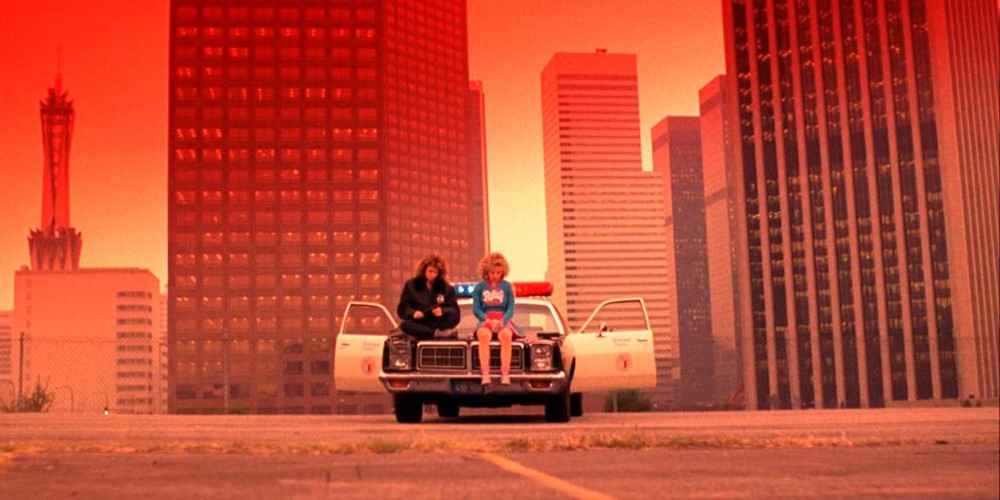
Teen sisters Reggie (Catherine Mary Stuart) - sporting Brooke Shieldsian brows and big, blown-out Dynasty hair - and Sam (Kelli Maroney) - sporting a big, blown-up, bubble blonde perm - are on the run from the post-apocalyptic comet event that has turned most of the population into red dust. It doesn't matter that both actresses were in their mid 20s when playing 18 and 16 respectively, just go with it.
"Petulant" looks good in the ketchup and mustard realness that Sam sports:
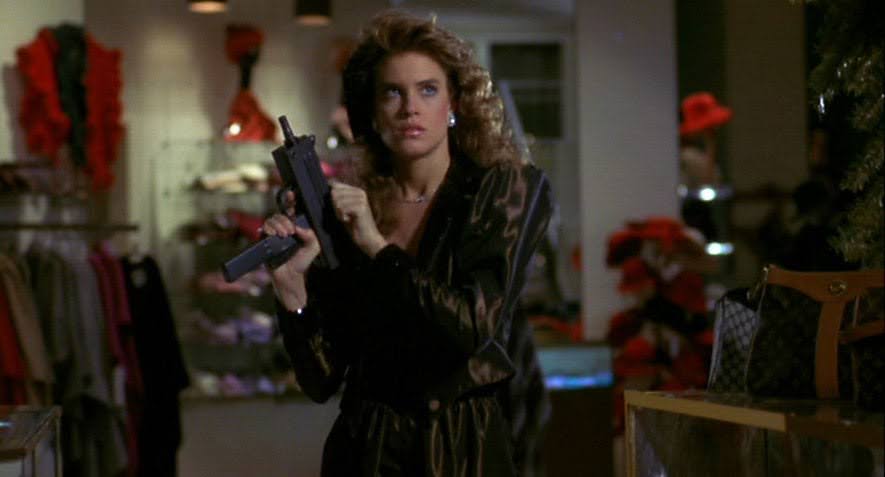
Uzis and hair dryers are their weapons.
It's great to see two young women as action leads in a 33-year-old movie, even if it was relegated to B-movie status. The $700K production made a profit of $14.5 million at the box office. B-movie can be big business.
Although some of the FX are shoddy and laughable, shots of the desolation vibe in the middle of a red-tinted, empty downtown L.A. is quite stunning, especially for such a small indie film.
The first half of Comet is a fun '80s blast of adventure, the sizzle of teens loose in the city. One of the most iconic parts of the movie is the sisters' shopping spree through an abandoned mall.
It wouldn't be the '80s without a montage sequence of trying on clothes, all set to a piss-poor cover of Cyndi Lauper's 'Girls Just Wanna Have Fun.' But the shoulder pad, mid-'80s businesswoman warrior look is on point.
Drop the blush brush, grab the Uzi.
Trying on ropes of pearls and fur coats comes to an end when they battle a bunch of teenage boy zombies who rule the mall. It's a fun, actiony stand-off and a highlight of the film.
But once the subplot about a small band of evil scientist/survivalists becomes the main plot, Comet starts to trail off. It becomes a bit of a Day of the Dead knock-off, with a slow, dull vibe that sputters when it could have been fast-paced and high octane. Instead the final third of the film becomes the slowest 95-minute "action film" you've ever seen.
But don't worry, the girls win...and rock an epilogue, with a simple one-piece bathing suit, beach wrap, and plastic mesh carry-all.
While Sam goes for fun in the sun, Reggie decides on buttoned-up, sister-wife, Mormon mother of two.
Although fondness for the fun, dumb, Reagan-era apocalypse of Comet is strong, I feel like a modern remake could be great, if done well. A sacrilegious idea to some, I know. But if someone with the sharpness of Ben Wheatley (Kill List, High Rise) or Edgar Wright (Shaun of the Dead, Baby Driver) got a hold of it, maybe it could sing? I'd gladly write the script.
As summer bakes on and we hit 105 degrees today and 108 tomorrow, we fantasize about being in a dark, shaded forest in October at 55 degrees. That's the setting of this overlooked indie, directed by Trey Edward Shults, that is being billed as a 'horror movie' but is more a psychological drama/thriller.
It Comes at Night stars edgy Joel Edgerton (fantastic, as usual) as Paul, husband and father who is hiding out in a cabin in the woods with his wife Sarah and teenage son Travis after some sort of unnamed health catastrophe has seemingly affected the world (nuclear war, plague, zombies?).
Their life is upended as Will, a young man, breaks into their sealed-up house looking for food, and winds up becoming their captive. They quickly ease their grip on Will and Paul goes with him to bring back his wife and young son to their cabin.
They all return safely to stay in the cabin but let's just say paranoia, cabin fever, anxiety, and creeping fear take hold of everyone involved and things go from bad to worse.
Although promoted with a very "scariest bits" trailer (above), this movie was not a "zombie film" or even much of a gory horror B-movie. It is truly a psychological horror film about survival, family, and fear. Also throw on heavy doses of mistrust and breakdown of society's rules and a dash of the (un)kindness(?) of strangers.
With a tiny budget and few recognizable actors, the small-scale It Comes at Night delivers with a fantastic sense of mood and place, a slow burning turning of the screws, and some stellar acting. Unanswered questions and motivations are littered throughout the picture to put you on edge and keep you guessing what's happening and why are people so cruel.
Deep, dark, and brutal, It Comes at Night scores more with its mundane, quiet take on the end of the world than the latest seasons of cacophony on The Walking Dead.
In all my mid-'80s, HBO/Cinemax-watching glory, I never managed to catch a viewing of Sylvester Stallone's cheesy arm wrestling drama Over the Top. It looked like a combo action-adventure meets family melodrama...with semi trucks. I was...semi-interested.
Like another mid/late '80s cheeseball macho epic, Road House, I assumed at the time that it was not for me. I was wrong. I viewed Road House's ridiculous glory a few months ago. I had to check out this arm wrestling flick.
Because Over the Top is almost too stupid for words, how about we go with images?
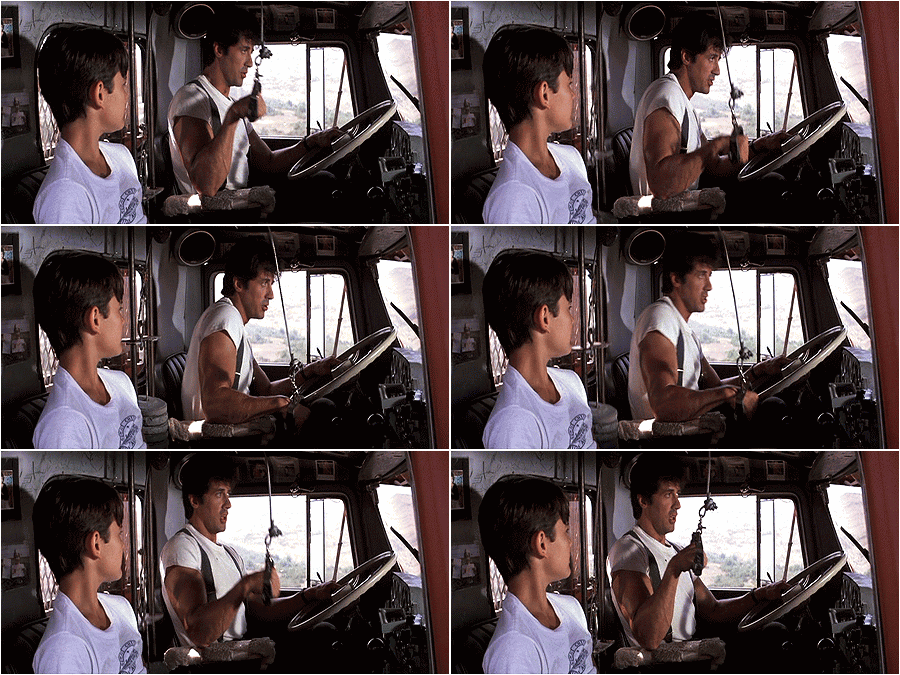
He has pulley weightlifting gear....IN HIS TRUCK.
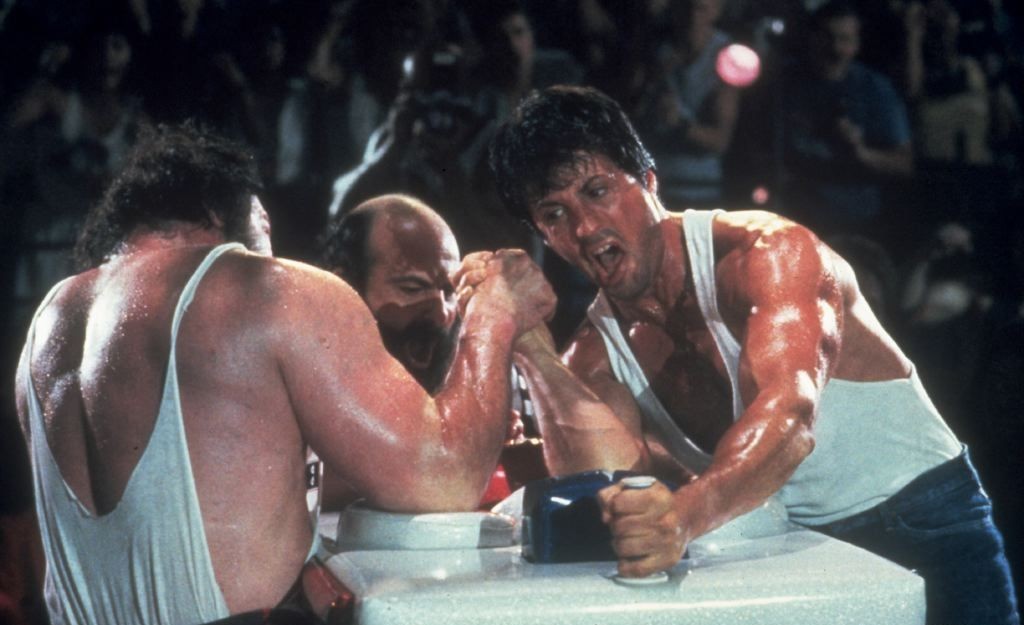
Stallone in full sideways mouth grunt/yell/scream. You'll get to see it a few times in the film.
You know Stallone's character Lincoln Hawk (not his porn name) means business when he moves his baseball hat backwards. He's ready to fight.
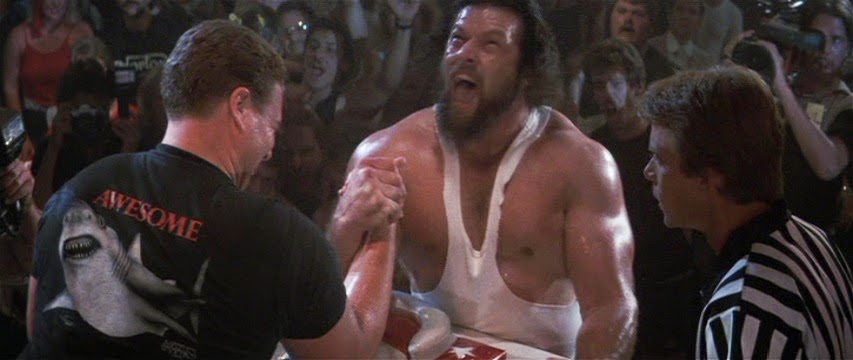
Arm wrestling competition contestants with chest-baring skank tanks and "awesome" shark t-shirts.
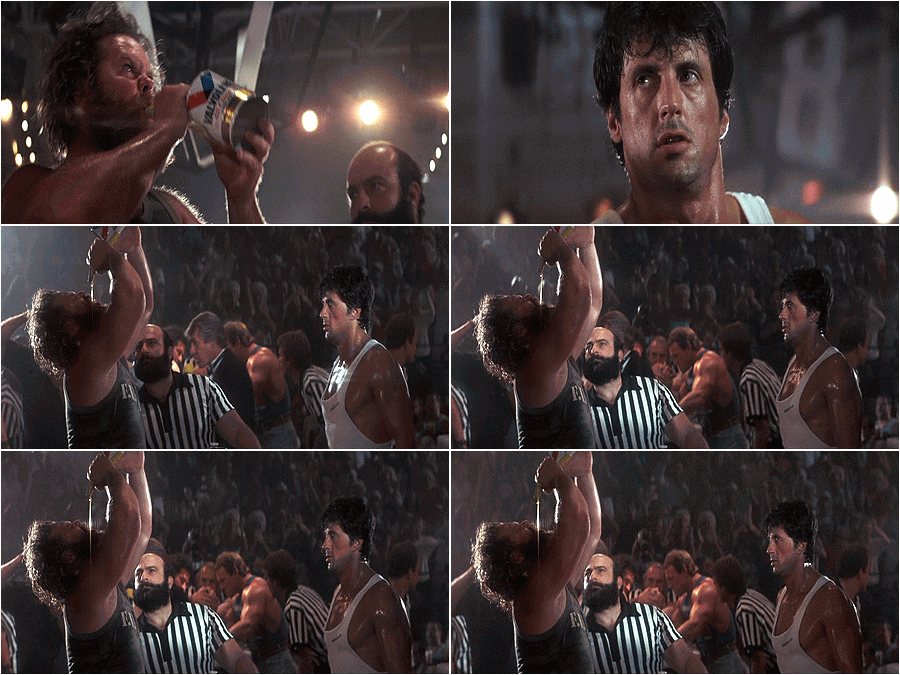
"Crazy" greasy bearded wild man wrestler drinking from a can of Valvoline motor oil (coz...reasons?) while Stallone and a hot bear referee look on in....disgust(?)
Bug-eyed, not subtle, loudmouth, main wrestler villain in his (not cool) 'BLASTER' t-shirt.
BLASTER possibly trying to pick up Stallone in a bar. Sylvester is stand-offish, aloof, and not into it.
Kenny Loggins teamed up with Giorgio Moroder (on the edge of his mid-'80s downturn) for the schlocky power ballad 'Meet Me Halfway.' It could not save the melted Velveeta cheese score.
Explain this look.
Action figures for your own fan fiction moments.
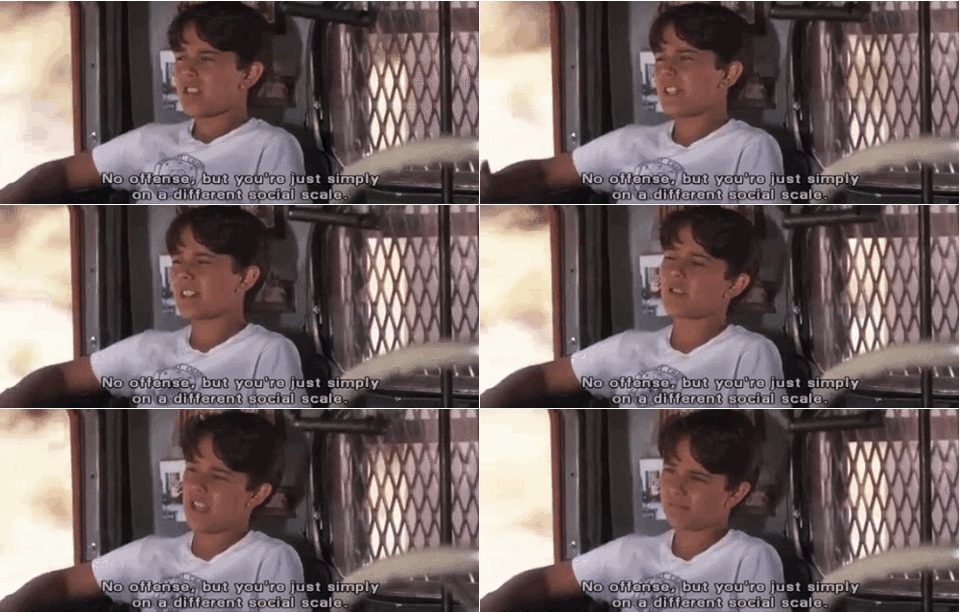
Lincoln Hawk's creepy, uptight tween son Mike Hawk is the other main character of the film. The character is supposed to be maybe 12-years-old but was played by a tiny, pre-pubescent 16-year-old actor.
Hey Mike, don't wear pristine white jeans to a grimy arm wrestling meet.
As we all know, the '70s in Hollywood is seen as a second Golden Era, where scrappy film school grads came into their own, using big money from eager studios to rope in a youth generation raised on a druggy counterculture vibe.
Scorsese, Coppola, Lucas, Spielberg, they all went big ideas and bigger budgets by the time 1980 rolled around. Ken Russell, the iconoclastic British director was a bit older than this crew and spent the '70s breaking down boundaries with films like the controversial anti-religious bombast of The Devils and the more user-friendly, rock opera psychedelia of The Who's Tommy. Russell was also edging toward the mainstream by the end of the '70s, looking for a pop hit that mixed his opulent weirdness and some kind of sci-fi angle that Hollywood was gaga for, post Star Wars.
[Back in an era when movie posters were allowed to have paragraphs of copy on them for movie-goers to read. We'd be lucky for a full sentence nowadays.]
Russell adapted the sole novel by Oscar-winning screenwriter Paddy Chayefsky (the genius behind Network) to the screen with his usual psychedelic aplomb. This is the story of Edward Jessup, a research psychologist (a striking William Hurt in his screen debut) studying schizophrenia by using sensory deprivation in an isolation water tank.
This deprivation isn't enough to get the out of body experiences he desires, so he travels to remote Mexico to experience a sacred drug ceremony. There, the natives use a special hallucinogenic natural potion to open up their consciousness. Jessup tries it and is hooked on the mind trip hallucinations.
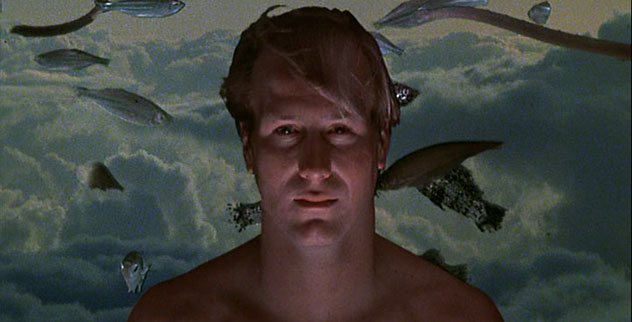
Back in Boston, Jessup mixes the isolation tank experience with some of the mind-altering drug mixture from Mexico. This is when the film gets truly silly and Hurt's hallucinations manifest themselves physically. He starts to morph into a caveman/animal state, escaping the tank and running amok through the nighttime city streets.
Altered States is a whole lot of mumbo jumbo, psuedo-science but makes for a fun, dated ride through theories about "biological devolution," energy waves, and bad primitive caveman bodysuits. It's the dead serious, existential questions about the origin of man and men becoming godlike through drug and mind-expansion tools that all seems very '70s self-help meets heavy drug experimentation. Russell puts this through a filter of a glossy, FX-heavy sheen of the upcoming '80s wave of sci-fi, horror, and action films about to barrel through Hollywood and become the norm.
Altered States rides the tightrope between the two decades and between exciting boundary-pushing and schlocky fun. It's too silly to even get mad at. C'mon, we're all just energy, man! Enjoy the ride.
Sorry for a blog vacay, but we had guests in town but nothing that would constitute a dinner party like the one in Miguel Arteta's new film Beatriz at Dinner.
Arteta, director of dark comedy slices of life like Chuck & Buck and The Good Girl, once again teams up with his writing partner, the wry and dry Mike White, for Beatriz.
Car trouble strands masseur/alternative medicine therapist Beatriz (the dressed-down, stunning Salma Hayek) at the oceanside mansion of one of her clients, Kathy (Connie Britten) post-session. She's invited to stay for a small dinner party. The guests include Kathy's stuffy, uptight husband, and his business associates, including the uber-wealthy CEO of a chain of hotels and resorts Doug Strutt (John Lithgow, playing creepy jerk again).
Beatriz's calm, open persona gets battered as she listens to the stories of greed, inanity, and selfishness from the wealthy white people sitting next to her at this lavish dinner table.
As the night moves on, the drinks are consumed, and Lithgow's character reveals himself to be a Trump-like classless, arrogant mogul who has leveled small towns, like the ones that Hayek's character comes from in Mexico, to make way for his luxury resorts. Beatriz moves from apologetic and gracious to silently, and then not so silently, seething.
Many critics have complained that the satire and comedy elements are not scathing enough in the film, while also complaining that the "villains" in the film are too one-dimensional.
I disagree. On reflection, the layers of this film are subtle when they could have turned into the over-the-top dark comedy of something like the liberal vs. conservative battles of the '90s indie The Last Supper . Beatriz approaches a vaguely similar "us vs. them" set-up, but adds the weight of race, class, and environmentalism, to take the idea of the story to a sadly accurate spot in 2017 America.
Although the ending is a bit pessimistic, it's also reflective and powerful and doesn't give anyone an easy out. Beatriz, mainly due to the haunted and silently commanding presence of Hayek, jumps over the danger of sermonizing, to focus on one single person and her small life affected by a wave of greed and narcissism that has flooded over this country in an era of corruption in the highest offices of the land.